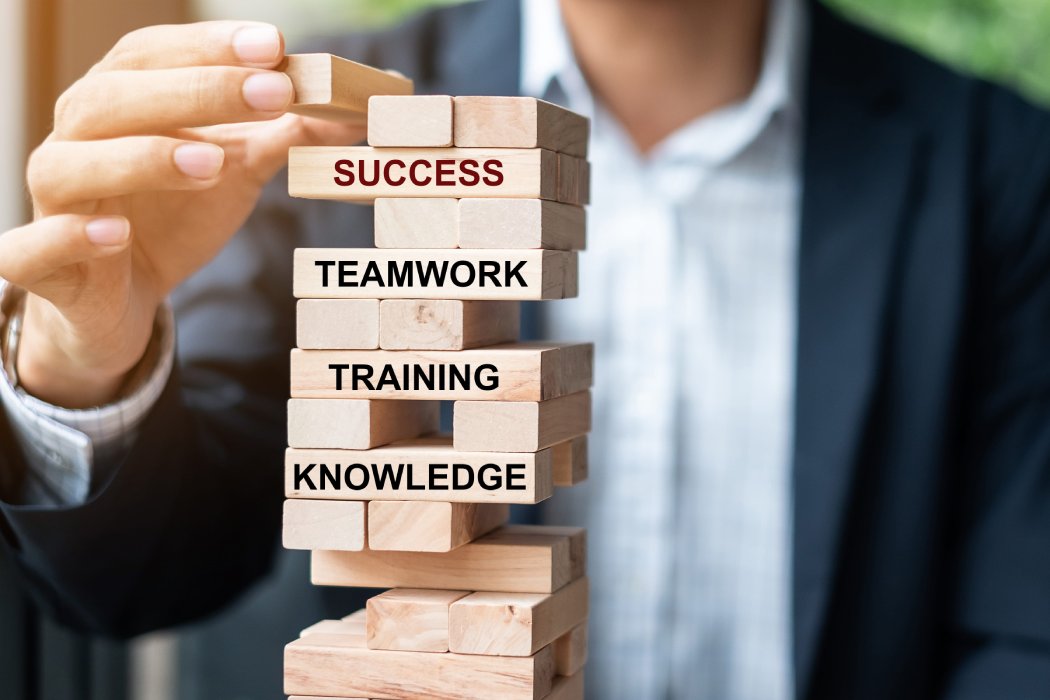
Teamland’s AI First® workshop is an example of this kind of training done with intentional design: focused on business outcomes, grounded in practical application, and built to move teams from theory to capability in hours, not weeks.
What an Innovation AI Training Workshop Really Is
An Innovation AI Training Workshop is not a classroom lecture about algorithms or abstract concepts. It’s a structured, applied intervention that blends:
- Hands-on practice with real tools
- Relevant business contexts
- Collaborative problem-solving
- Measurable outcomes that matter to the organization
Participants walk out not with slides, but with usable workflows, repeatable approaches, clearer goals, and the confidence to apply what they learned immediately.
Teamland’s AI First® program embodies this approach. It delivers both foundational AI fluency and strategic insights that help teams apply AI to marketing, operations, customer service, and leadership decision-making, not just in theory, but in real business contexts.
What Are the Core Elements That Define Effective AI Training
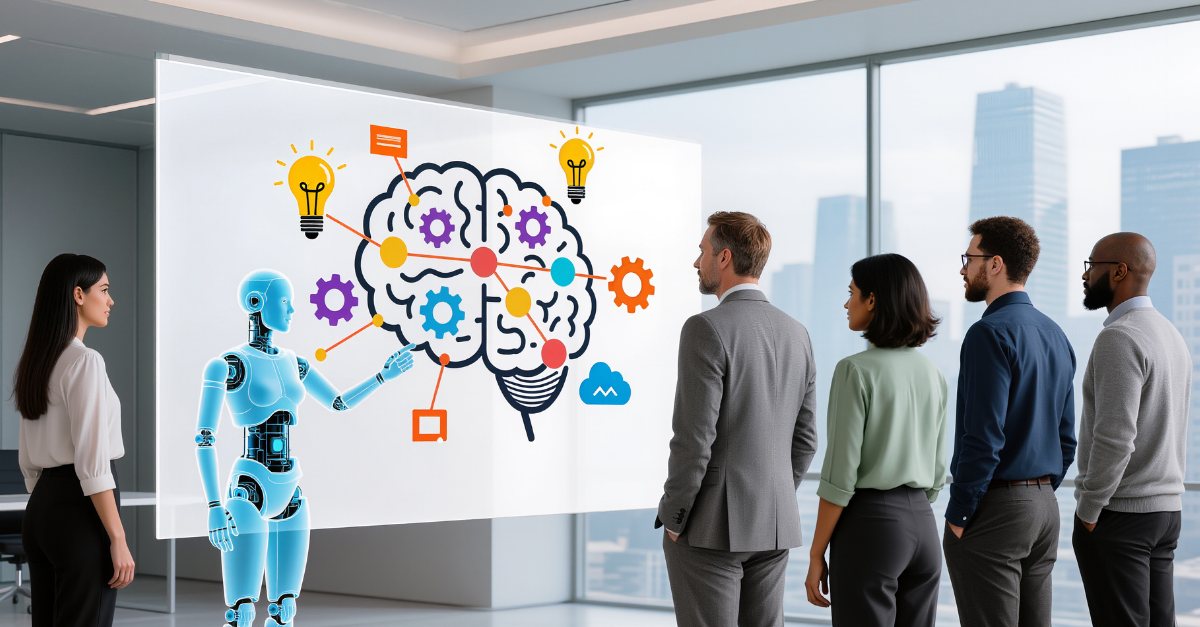
The most effective AI workshops start with the work teams are already doing, not abstract hypotheticals. Participants bring live projects, recurring challenges, and real workflows into the room. That context makes the experience immediately relevant and ensures outcomes translate directly to measurable performance.
Here’s what that looks like in practice:
- Identify bottlenecks: Teams map out repetitive, manual, or decision-heavy steps that slow progress, from campaign approvals to financial reporting.
- Apply AI as a collaborator: Instead of viewing AI as a replacement, they use it as a co-pilot, streamlining steps, generating drafts, or analyzing patterns faster.
- Document new models: Teams capture optimized templates, SOPs, and workflow adjustments they can implement right after the session.
This use-your-own-work approach removes abstraction. It shifts the mindset from “AI might help us someday” to “AI is already helping us now.”
When people experience direct improvements in their tasks, saving hours, reducing errors, and seeing tangible progress, belief becomes behavior. That’s what separates effective training from awareness events that fade by Monday morning.
1. Hands-On Practice with Tools and Frameworks
Good AI training feels like a working lab, not a lecture.
Participants learn through guided experimentation, using tools they already know by name but may not yet know how to apply effectively.
Common exercises include:
- Generative tasks: Using ChatGPT or Claude to rewrite emails, summarize reports, or create variations of marketing copy.
- Process automation: Exploring Copilot or Gemini for structured data tasks, research, and project tracking.
- Prompt engineering frameworks: Learning how to design and test prompts that yield consistent, usable results, customized for sales, product, HR, or strategy teams.
- Industry-based scenarios: Hands-on simulations modeled on real cases (e.g., customer support automation, content personalization, or data interpretation).
- Reusable assets: Participants build prompt libraries, process templates, or checklists they can integrate into their daily workflow.
AI stops being an abstract concept and becomes a practical skill set. Teams don’t leave with just “knowledge”; they leave with tools, methods, and outputs they can replicate immediately.
It’s this tangibility, learning by doing, that transforms AI literacy into AI fluency.
2. Cross-Functional Collaboration
Innovation rarely lives in isolation.
That’s why effective AI training intentionally brings together people from different departments and roles, marketing, engineering, operations, finance, HR, and leadership.
Cross-functional participation multiplies both creativity and impact. When a marketer hears how an engineer automates workflows, or when leadership sees how content teams use AI to improve output quality, knowledge spreads organically.
Why this matters:
- Shared perspective: Everyone understands how AI fits into the broader business system, not just their silo.
- Faster decision-making: Ideas move from concept to cross-department execution without endless translation.
- Cultural adoption: When multiple functions experience success together, change feels collective, not imposed.
In Teamland’s workshops, this dynamic is built into the design. Sessions often include structured co-creation sprints where different departments collaborate on a single shared workflow. The result: AI adoption accelerates because everyone sees its value through their own lens.
Cross-functional innovation turns AI training from a technical exercise into a cultural shift.
3. Iterative Learning and Quick Prototyping
AI learning works best when it mirrors the way innovation actually happens, through cycles of trial, reflection, and refinement.
Rather than aiming for perfect answers, participants are encouraged to experiment:
- Run a small test.
- See what works.
- Refine and re-run.
This iterative rhythm, often framed as “build → test → learn → repeat,” builds confidence faster than static instruction.
Typical workshop flow includes:
- Idea sprints: Short, time-boxed challenges where teams generate solutions using AI tools.
- Rapid testing: Teams apply prompts or workflows immediately and see results in real time.
- Live feedback loops: Facilitators coach participants through what worked, what didn’t, and how to adjust.
- Reflection blocks: Each cycle ends with teams capturing insights and process improvements for next use.
By the end of the session, participants don’t just understand how to use AI, they’ve internalized how to think iteratively.
This mindset is critical: once people stop waiting for “the perfect prompt” and start learning through experimentation, innovation becomes continuous.
4. Strategic Structures That Guide Action
Creativity without structure can be chaos.
That’s why the best workshops use frameworks to guide experimentation toward outcomes that matter, measurable, actionable, and aligned with business strategy.
Teamland often integrates frameworks such as:
- AI Workflow Mapping: Teams visualize where human effort meets automation, identifying leverage points and redundancy.
- Value Prioritization Lenses: Ideas are scored by potential impact, effort required, and organizational relevance, helping teams focus on what truly moves the needle.
- Governance & Risk Frameworks: Built-in guidance ensures all experimentation stays within safe, compliant boundaries, particularly around data privacy and accuracy.
- Pilot Roadmaps: Each team leaves with a 30-60-90-day roadmap to implement and measure their AI-enhanced processes.
- AI KPIs: Metrics like time saved, workflow throughput, content quality, and cross-team adoption rates provide a tangible way to measure success.
These frameworks anchor creativity in accountability.
They ensure a workshop isn’t just inspiring but operationally valuable, something leadership can track, optimize, and scale.
In short: structure turns creative exploration into sustained transformation.
How Does Teamland's AI First® Model Deliver Effective Innovation Training
Teamland’s AI First® workshop is built around exactly these elements, and its design reflects decades of learning about what helps teams adopt AI in practice.
The Training, Defined
AI First® is a trademarked training program by Teamland that combines:
- Strategic AI literacy (how AI works and where it matters)
- Applied problem solving (using AI to solve real business tasks)
- Leadership integration (aligning strategy, decision-making, and operations)
- Ethics and risk management (guardrails that make AI adoption safe and sustainable)
It’s designed for executives, teams, and organizations seeking not just fluency, but measurable outcomes.
Group size can range from small strategic cohorts to larger cross-functional groups, and sessions are available both virtually and in person, fitting the needs of distributed and hybrid teams.
What Real Outcomes Does AI First® Deliver
Teamland’s AI First® program has produced measurable impact in just a single workshop, especially for sales and marketing teams. These aren’t anecdotal claims; they’re concrete outcomes participants reported:
ROI Headline
"In just one workshop, we identified 30 hours of weekly savings for the team. That projects to 1,500+ hours saved annually, purely by optimizing workflows they already own." This equates to about 2.5 hours saved per person per week on tasks that used to consume time with manual effort.
Capability Shift
Before the session, 23% of participants relied entirely on manual processes. Afterwards, that number dropped to 0%, and 58% felt fully equipped to be ‘Workflow Optimizers’ starting the next day.
Leadership Transformation
A group that began with 46% passive “bystanders” shifted to 75% confident “AI Champions” or strategists ready to lead adoption across the organization.
Mindset Guarantee
70% of participants leveled up their AI fluency mindset by at least one stage (from curious to capable), and 100% left with a clear understanding of data guardrails, reflected in a 4.0 out of 5 safety score on responsible AI use.
These results show that, when applied well, AI training leads to immediate productivity improvements, culture shifts, and leadership readiness.
What Makes These Results Possible
Transformative outcomes like those seen in Teamland’s AI First® program don’t happen by chance, they’re the product of a learning design built on psychology, structure, and strategic intention. Each workshop is engineered to close the gap between knowledge and execution, so participants leave not just informed, but capable of real change.
Applied Fluency Over Abstract Learning
Traditional training often stops at understanding; participants learn definitions, frameworks, or the “theory of AI.” But theory alone doesn’t create transformation.
Teamland’s workshops focus on applied fluency: the ability to use AI tools instantly and confidently within real workflows. Participants don’t just talk about AI; they apply it to the emails, reports, campaigns, and planning documents they handle every week.
They learn by:
- Rewriting existing tasks through AI assistance.
- Testing prompt structures that directly mirror their workflows.
- Measuring time and quality improvements in real-time.
This direct application makes learning “stick.”
By anchoring each activity to a team’s daily reality, the gap between “training” and “doing” disappears. Participants don’t leave wondering how AI fits; they’ve already used it, felt the time savings, and proven its value in their own work.
That’s what Teamland calls fluency through function: real skills in real time, applied to real work.
Alignment Across Roles
The real test of any AI transformation isn’t individual skill, it’s collective clarity.
That’s why Teamland designs AI First® sessions to include a mix of functions and levels: leadership, operations, marketing, and creative teams working together in one environment.
When everyone learns in the same room or virtual room, several things happen:
- A shared vocabulary emerges. Words like “automation,” “prompt,” or “AI workflow” mean the same thing to everyone.
- Teams develop aligned expectations of what AI can (and can’t) do for their business.
- Leaders and contributors co-design realistic, safe implementation paths, reducing friction later.
This kind of alignment removes one of the biggest blockers to AI adoption: miscommunication between strategy and execution. By the end of the session, both leaders and team members can speak the same language of opportunity, one focused on efficiency, creativity, and responsible adoption.
Strategy Meets Execution
Most AI training focuses on tool literacy or technical capability. AI First® goes further; it connects those capabilities to strategic decision-making and measurable business outcomes.
Participants learn not only how AI works, but where and when it delivers the most impact. This means:
- Understanding how to evaluate a workflow for automation potential.
- Prioritizing AI projects based on ROI and risk.
- Building mini-roadmaps for adoption that balance speed with safety.
In practice, this turns theoretical AI understanding into operational playbooks. For example, a marketing manager might leave with a new content generation workflow, while a sales leader builds an AI-assisted outreach sequence, both aligned under a shared AI adoption strategy that leadership can scale.
The result is a company that doesn’t just “know about AI”, it acts strategically with it.
Teams return to work equipped to drive continuous improvement, supported by leaders who understand how to measure and manage the transformation.
What Fresh Perspectives Are Shaping Global AI Adoption

Instead of a static location list, it’s more revealing to look at how teams around the world are putting AI First into practice and why local context matters.
United States
In innovation hubs like San Francisco and New York City, teams use AI First® workshops to redesign workflows in customer insights and campaign planning. In tech-intensive markets like Seattle and Los Angeles, product and creative teams focus on rapid ideation and automation. Chicago organizations are applying AI to operational efficiency and data-based decision processes.
Europe
Teams in London and Berlin integrate AI into strategy, governance, and cross-functional collaboration. In Paris and Amsterdam, sessions often emphasize multilingual understanding and customer engagement optimization. Zurich teams apply AI First® to compliance, financial reporting, and risk assessment.
Canada
In Toronto and Vancouver, companies are using workshops to speed project handovers, improve internal reporting, and build shared capability across distributed teams.
Across regions, the core pattern holds: teams that adopt AI First® gain practical fluency, tailored workflows, and strategic alignment, not just awareness.
How Do You Measure What Matters
Effective workshops are judged not by attendance or slides, but by post-training outcomes, the things leaders and teams actually use in their work.
Here’s how organizations measure success:
- AI adoption metrics (frequency of AI tool usage).
- Workflow efficiency gains (time saved on recurring tasks).
- Innovation outputs (new pilots, prototypes, ideas in the pipeline).
- Team collaboration and alignment scores (surveys or feedback).
- AI fluency improvements (pre/post assessments).
When these metrics show positive trends, training becomes a competitive advantage, not an expense.
Final Takeaway
True innovation training doesn’t just make teams aware of AI, it makes teams capable of using it to solve real business problems.
Workshops that combine hands-on practice, relevance, collaboration, iteration, and measurable outcomes deliver lasting impact. Teamland’s AI First® program exemplifies this approach, blending strategy, capability building, and safety into a learning experience that changes how teams work.
When your team stops asking “What can AI do?” and starts asking “What can we do with AI?”, that’s when transformation begins.
Ready to plan your next experience with Teamland?
FAQs
What are the main benefits of an AI workshop for teams?
AI workshops help teams understand how to apply AI tools to everyday tasks, improving productivity and innovation. Participants engage in hands-on activities that demonstrate real-world applications, such as automating processes, streamlining workflows, and enhancing collaboration. These sessions can spark creativity, increase efficiency, and foster a data-driven decision-making culture across the organization.
How does AI training improve productivity and efficiency in businesses?
AI training helps teams identify and automate repetitive or manual tasks, which can free up time for more strategic work. By learning how to use AI tools effectively in context, employees can speed up routine processes, reduce errors, and focus on higher-value activities, leading to measurable boosts in productivity and operational efficiency.
What challenges do teams typically face during AI training, and how can workshops address them?
Teams may struggle with integrating AI into workflows or understanding how to use tools effectively. Effective workshops combine structured learning with hands-on experimentation and context-specific examples, helping teams see where AI fits in their work and how to apply it safely and correctly. Tailoring content to team needs and building confidence with tools helps overcome common adoption barriers.
Can AI training help foster collaboration and teamwork?
Yes. AI training often involves group work and collaborative problem-solving, which strengthens communication and coordination. When teams learn and experiment together, they develop shared language and goals, leading to better alignment and more effective collaboration across departments.
Why is hands-on, practical AI training more effective than theoretical courses?
Hands-on training that focuses on real tasks and use cases helps teams directly apply AI tools to their work. This practical approach improves retention, builds confidence, and accelerates adoption because people can immediately see the impact of what they’ve learned, unlike theory-only training that often feels detached from daily work.