At Teamland, we’ve seen how structured learning experiences like our Creativity AI Workshop and AI First Corporate Training help teams move beyond routine tasks to more strategic and imaginative work.
These programs guide participants to apply AI tools in ways that improve everyday processes and spark better collaboration across functions.
When organizations shift their focus from “What can AI do for us?” to “What can we do with AI?”, measurable improvements in performance, idea generation, and workflow efficiency often follow.
What a Creativity AI Workshop Actually Does
A Creativity AI Workshop isn’t about abstract theory or coding; it’s about practical, hands-on experimentation. Teams bring their real projects into the room and apply AI directly to the challenges they face every day.
Over the course of the session, participants learn to use generative tools for brainstorming, workflow automation, data summarization, and creative prototyping. They test new approaches, refine prompts, and design workflows that cut repetitive work while unlocking stronger ideas.
By the end, teams walk out with tangible outcomes, reimagined processes, faster deliverables, and a clear understanding of where AI adds the most value. The session bridges imagination and execution, showing that AI isn’t just a tool for efficiency; it’s a catalyst for smarter thinking.
The focus isn’t on what AI is, it’s on what it makes possible: more creativity, faster collaboration, and measurable performance gains.
How It Differs from Traditional AI Training
Traditional AI training is about tools and technology. Creativity AI Workshops are about people, how they think, collaborate, and adapt with AI in the mix.
In practice, that means:
In practice, that means each workshop is designed as a collaborative sprint where strategy meets creativity. Teams don’t watch slides, they build solutions together.
- Cross-functional collaboration: Engineers, marketers, operations, and leadership work side by side to solve real challenges.
- Hands-on creation: Participants use tools like ChatGPT, Gemini, and Copilot to brainstorm ideas, summarize insights, and prototype new workflows.
- Build, don’t watch: Instead of demos, teams design and test AI-powered processes right in the room, applying what they learn immediately.
- Immediate impact: Everyone leaves with practical workflows they can implement the next day, not abstract concepts to file away.
- Scalable creativity: The goal isn’t mastering one platform; it’s developing a repeatable, creative mindset that can be applied across every project and department.
This is where AI learning becomes more than education; it becomes capability.
What Proven ROI Can You Expect From Teamland's AI First® Program
The best way to measure impact is to look at what changes after just one session.
During Teamland’s AI First Corporate Training, sales and marketing teams tracked immediate, measurable improvements that continued well beyond the workshop.
- Time ROI: By rethinking existing workflows with AI, teams uncovered 30 hours of weekly time savings, the equivalent of 1,500+ hours reclaimed annually across the organization. These weren’t new processes, just optimized ones built from what the team already owned.
- Capability Growth: Before training, 23 percent of participants relied entirely on manual methods. Afterward, that number dropped to zero. More than 58 percent left confident enough to act as “Workflow Optimizers,” redesigning daily tasks with AI tools.
- Leadership Transformation: In a two-hour session, a group that started with 46 percent passive “bystanders” shifted to 75 percent ready to serve as AI champions and strategists, guiding adoption across their departments.
- Mindset Upgrade: Seventy percent of participants advanced at least one stage in their AI fluency, from curious to capable and every attendee left with a clear understanding of responsible-use standards, earning a 4.0 / 5 safety score on data handling and ethics.
Each of these results reflects the same pattern: when creativity and technology are taught together, efficiency improves, confidence rises, and leadership naturally emerges
What Is the Real Impact of Creativity AI Workshops
What makes a Creativity AI Workshop different isn’t the tools, it’s the transformation.
When people get to apply AI in a hands-on, creative way, they stop seeing it as something abstract and start seeing it as a skill that changes how they work.
The results show up quickly: faster problem-solving, higher engagement, and a stronger sense of ownership across teams.
1. From Curiosity to Capability
Creative learning works because it’s experiential. Instead of listening to theory, teams dive straight into application, rewriting outreach templates, refining reports, optimizing workflows, or designing campaigns with AI assistance.
The moment the lightbulb goes off is when participants realize that AI doesn’t add complexity; it removes it. Across industries, structured creativity training has been shown to increase both idea output and quality, and when AI becomes part of that process, improvement compounds fast.
Teams walk away not just understanding AI, but knowing exactly how to use it to make their work simpler, smarter, and more creative.
2. Real Problem-Solving, Real Progress
Every team has bottlenecks, repetitive reports, slow approvals, endless coordination. A Creativity AI Workshop helps surface those friction points and gives participants space to rebuild them in smarter ways.
- A marketing team replaces manual data pulls with automated summaries.
- Sales teams use AI to qualify leads and personalize outreach instantly.
- Product teams create and test prototypes in hours instead of days.
By connecting imagination with automation, creativity stops being abstract and becomes a measurable advantage. What was once “nice to have” suddenly becomes essential infrastructure for better work.
3. Engagement That Lasts Beyond the Session
Training only matters if people remember it, and apply it.
Hands-on creativity workshops drive lasting engagement because participants see their ideas come to life immediately.
In Teamland’s post-session feedback, participants often describe these workshops as “the most useful two hours of learning in my career”, because what they learn applies that same day.
When people see how AI can remove repetitive work and elevate creative thinking, motivation spikes. Energy spreads. The mindset shifts from “AI might replace me” to “AI helps me do my best work.”
And that’s the kind of engagement that endures, not a temporary boost, but a permanent change in how teams see themselves and their potential.
What Leading Companies Already Know
Creativity-focused AI learning isn’t hypothetical anymore, it’s already shaping how global leaders innovate, build products, and empower teams. These companies treat AI not as a technical upgrade, but as a creative collaborator that helps people think, design, and execute faster.
IDEO — Design Thinking Evolved
IDEO’s AI × Design Thinking program merges human insight with AI’s generative speed. Teams prototype ideas faster, visualize creative directions in real time, and iterate on concepts that would have taken days without AI support.
The takeaway is simple: AI amplifies, but never replaces, human creativity.
Microsoft — Innovation Through Hackathons
Microsoft’s Global Hackathon functions as a company-wide creativity lab. Every year, thousands of employees form teams to solve problems they want to address, often utilizing AI as a co-creator.
Products like Microsoft Designer began in these sessions, proving what can happen when open exploration meets a structured creative process.
Spotify — AI and Experimentation Culture
Spotify’s Hack Week has become a model for creative experimentation. Breakthroughs like Discover Weekly and AI DJ weren’t formal projects; they started as playful, cross-functional ideas that merged human taste with machine intelligence.
The message is clear: creativity thrives when AI gives people more room to explore, test, and play.
Google — Fast Ideation with Gemini
At Google, teams use multimodal AI tools like Gemini to power idea sprints. Designers, strategists, and marketers storyboard, test, and align on creative concepts in hours instead of days.
The focus isn’t on the technology itself; it’s on how it accelerates collaboration, making collective creativity faster, sharper, and easier to scale.
What Makes These Workshops Work Everywhere
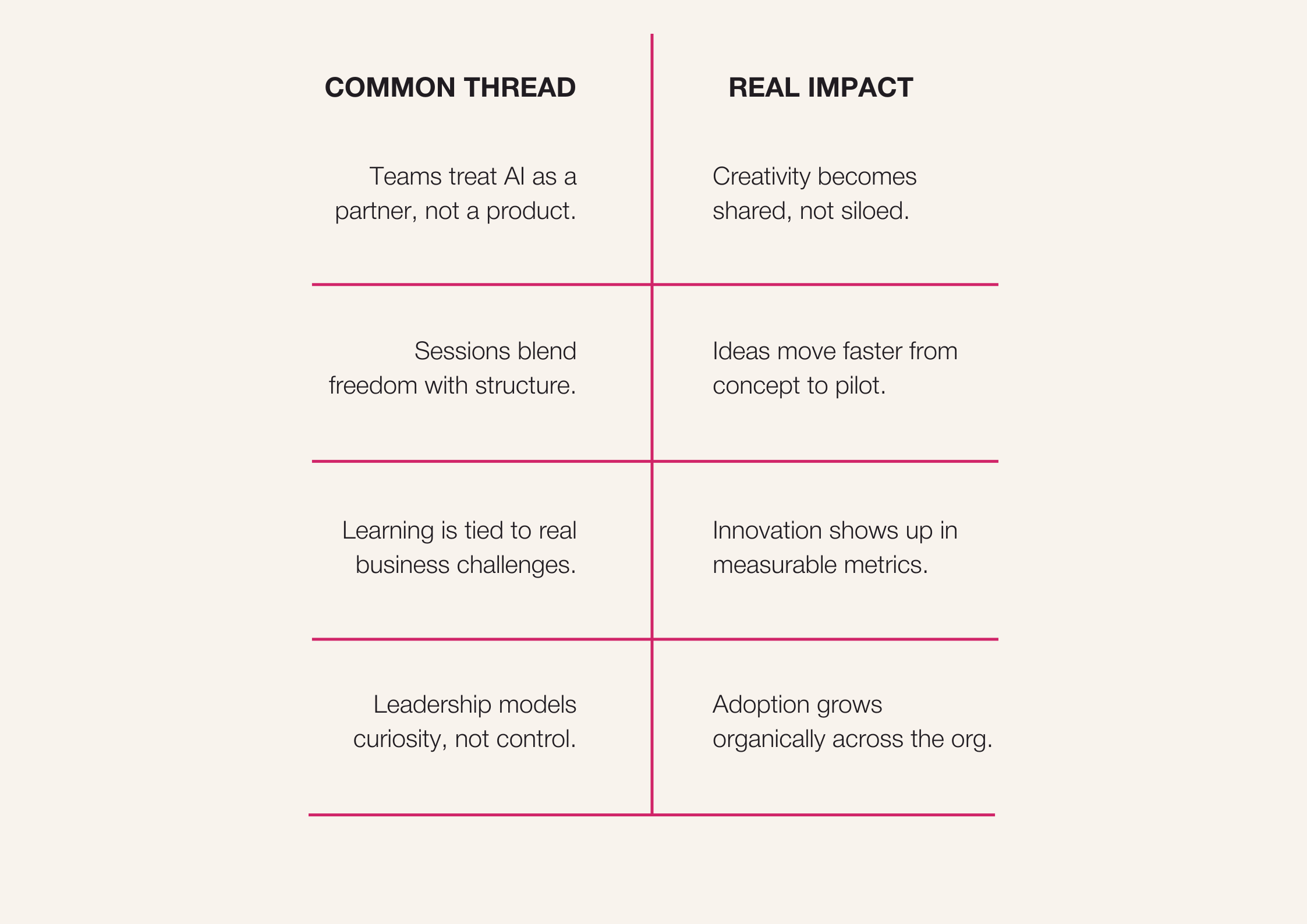
Why This Matters for Every Team
For HR and L&D Leaders
- Shift from generic “training hours” to creative transformation programs.
- Build team-wide fluency without technical prerequisites.
- Track outcomes, time saved, processes improved, and engagement lifted.
For Team Leads
- Give your teams permission to experiment and iterate.
- Use AI workshops to solve ongoing problems instead of abstract hypotheticals.
- Turn your top performers into AI mentors who help others adapt.
For Executives
- Connect creativity to measurable business results.
- Make innovation part of the company rhythm, not a side project.
- Empower everyone, not just tech roles, to contribute to AI strategy.
Why Is Creativity a Cultural Advantage
Creativity is the muscle that makes teams adaptable.
A Creativity AI Workshop strengthens that muscle by creating shared language, shared confidence, and shared ownership of innovation.
Teams that practice creative problem-solving:
- Collaborate more effectively across departments.
- Adopt tools faster and with less resistance.
- Generate ideas that tie directly to business growth.
That’s what makes this kind of learning stick, it feels authentic, not aspirational.
What Makes Teamland's AI First® Corporate AI Training Different
Teamland’s AI First® program is a trademarked, outcome-driven corporate AI training workshop designed to help organizations adopt and apply AI strategically, not just technically. It combines practical AI fluency with business leadership application to support teams in integrating AI into actual work contexts across functions such as strategy, operations, marketing, and customer service.
Key Characteristics of the AI First® Program
- Strategic focus: The curriculum covers foundational AI concepts like machine learning, NLP, data analytics, and automation, while also emphasizing leadership, decision-making, and competitive advantage.
- Hands-on learning: Participants engage with real-world examples and case studies to identify where AI can be applied in their own operations.
- Role-agnostic design: The program is appropriate for executives, senior leaders, and broader teams, with workshop formats tailored to varying group sizes (from small cohorts to larger, cross-functional groups).
- Practical outcomes: Workshops aim to help teams identify AI opportunities, develop pilots, and create roadmaps for adoption that include governance, KPIs, and integration into existing workflows.
- Flexible delivery: Sessions can be delivered virtually or in person, with options tailored to meet organizational needs and existing technology stacks.
Beyond workshops, Teamland also offers consulting components such as AI readiness assessments, business process reengineering, strategic planning for integration, leadership alignment, and staff upskilling roadmaps, making AI First® a strategic AI consulting solution, not just a training event.
Global Reach: Where to Experience a Teamland AI Workshop
What started as a handful of pilot sessions has turned into a global movement.
Teams everywhere are carving out space to think more creatively, collaborate more openly, and use AI more confidently, and Teamland is helping make that happen.
From San Francisco to New York City, companies across the U.S. are running AI First Workshops that blend strategy, creativity, and hands-on practice.
In Seattle and Los Angeles, fast-moving tech and creative teams are using Teamland’s sessions to rethink how cross-functional work gets done, from content creation to customer experience.
Meanwhile, Chicago has become a proving ground for operations and marketing teams eager to scale efficiency without losing creativity.
Across the Atlantic, the energy feels just as strong.
European cities like London, Berlin, and Paris are leading the charge on human-centered innovation, showing how AI can be integrated into existing systems while respecting data governance and local nuance.
In Amsterdam and Zurich, global enterprises and startups alike are using these workshops to align teams across time zones and functions, turning creative consistency into a measurable strength.
And north of the border, Toronto and Vancouver are proving that hybrid work doesn’t have to mean disconnected work.
Canadian organizations are using Teamland’s Creativity AI Workshops to close the distance between departments, blending virtual tools with real collaboration in ways that make learning stick.
Each city brings its own flavor: finance in New York, design in Amsterdam, entertainment in Los Angeles, but the results share a pattern: stronger collaboration, faster problem-solving, and a visible lift in creative confidence.
No matter where it happens, the outcome feels the same: people leave not just trained, but transformed, clearer, faster, and far more connected to what’s possible with AI.
How Can You Create a Lasting Shift With AI
When creativity becomes a skill, not just a spark, performance compounds.
It’s no longer about having a few innovators in the room; it’s about giving every team the tools and confidence to innovate together.
That’s the transformation these workshops deliver.
People stop waiting for permission to explore. They start testing ideas, iterating on them, and building momentum one small experiment at a time.
The result is an organization that doesn’t just adopt AI, it adapts with it.
A Creativity AI Workshop isn’t about turning employees into data scientists or automation experts. It’s about helping them think like innovators, curious, confident, and capable of using AI to amplify what they already do best.
Once that mindset clicks, collaboration shifts. Teams don’t default to “we can’t,” they ask “how might we?”
Leaders stop focusing on tools and start focusing on outcomes. And the culture moves from compliance to creativity, from routine to reinvention.
Because once your people start seeing AI as a creative partner, work feels lighter, ideas move faster, and performance becomes something you can feel, not just measure.
This isn't a theory. It’s a new rhythm for high-performing teams, and it starts with one workshop, one team, and one spark of possibility.
Ready to plan your next experience with Teamland?
FAQs
What is an AI workshop?
An AI workshop is a focused, interactive session where participants actively engage with artificial intelligence concepts, tools, and practical applications. Unlike lengthy courses, workshops concentrate on specific topics and emphasize hands-on application, discussion, and collaboration among participants to address real business or project challenges.
How does an AI workshop help teams apply AI in real work?
AI workshops are designed to move participants from theory to practice. Through structured exercises and facilitator guidance, teams gain practical experience with AI tools and learn how to apply them to actual tasks and workflows, improving understanding of where and how AI can deliver value in a business context.
What are the key benefits businesses get from AI workshops?
AI workshops support informed decision-making, help teams identify and implement AI use cases, enhance collaboration around AI adoption, and contribute to productivity and professional development. They provide a practical context for learning that is aligned with organizational objectives.
Who should participate in an AI workshop?
Workshops are suitable for a wide range of roles, including business leaders, managers, and non-technical professionals, as well as technical contributors. Effective workshops are tailored to the audience’s needs so that each participant can directly apply AI concepts to their daily work.
How do AI ideation or innovation workshops differ from traditional training?
AI ideation or innovation workshops focus specifically on generating new ideas, identifying transformation opportunities, and aligning teams around strategic use cases. These differ from traditional training by emphasizing creative problem-solving with AI and facilitating activities that lead to business design thinking and ideation, rather than just presenting technical content.