
That gap between scattered usage and scalable adoption is where AI maturity becomes critical. Many organizations begin addressing it through structured programs like Teamland's AI First® training workshops, which help teams move from experimentation to consistent AI adoption.
.jpg)
AI maturity is not about access to tools. It is about how deeply AI is embedded into the way work actually gets done. Some organizations are still in early stages, where usage is inconsistent and invisible. Others have introduced tools and policies, but lack repeatable workflows. A smaller group has aligned training, processes, and governance to create real impact.
The difference between these stages determines how much value AI can actually deliver.
Why AI Maturity Matters for Your Organization
Many AI initiatives stall because companies treat AI like a software rollout instead of an operating shift. They introduce a tool, send guidelines, and expect adoption to follow.
In reality, teams need structure, clarity, and support before AI becomes part of daily work. This is the core philosophy behind Teamland's AI First® approach to organizational AI adoption. Without that, usage stays fragmented.
Research from MIT Sloan Management Review on AI adoption challenges shows that most organizations investing in AI still struggle to achieve meaningful business impact.
AI maturity provides a practical way to:
- Understand where your organization stands
- Identify gaps preventing scale
- Align teams around consistent usage
It also explains why one team may be thriving with AI while another barely uses it.
How AI Adoption Actually Happens
In most organizations, AI adoption doesn’t follow a clean rollout.
It happens in two parallel ways:
Bottom-Up Adoption
Employees discover AI tools and start using them independently. This creates early wins, but also risk and inconsistency.
Top-Down Adoption
Leadership introduces tools and encourages usage, but without workflow changes, adoption remains optional. Most companies experience both at once, which is why adoption often feels messy.
This is also why many organizations turn to hands-on programs like AI First® corporate training to create alignment between strategy and execution.
Teamland's AI First® methodology is designed to help organizations progress through these maturity stages by combining AI literacy, workflow design, practical implementation, and long-term adoption support.
The 7 Stages of AI Maturity (And Where Most Companies Stall)
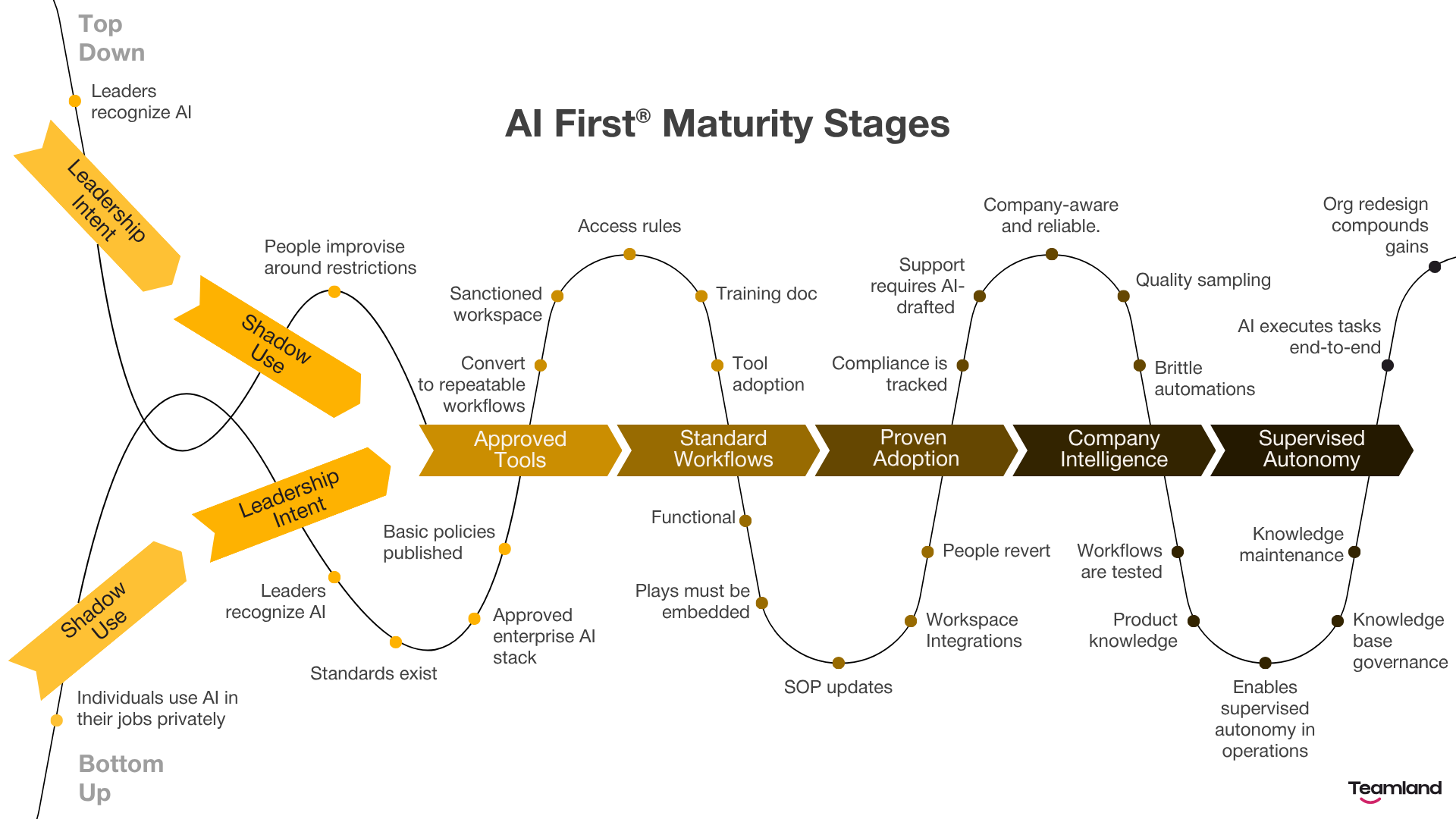
1. Shadow Use
Employees use AI informally with no visibility or standards.
2. Leadership Intent
Leaders recognize AI’s importance, but workflows remain unchanged.
3. Approved Tools
Organizations introduce tools and policies, but adoption is inconsistent.
4. Standard Workflows
AI becomes embedded into how tasks are completed. This is where real transformation begins.
5. Proven Adoption
Usage becomes consistent, measurable, and repeatable across teams.
6. Company Intelligence
AI integrates with internal data, improving accuracy and trust.
7. Supervised Autonomy
AI executes workflows end-to-end with human oversight.
Where Most Companies Get Stuck
Most organizations don’t fail because they never start. They get stuck between tools and workflows. A company may introduce AI tools, run training sessions, and encourage experimentation. But if workflows are not redesigned, nothing changes.
This is why AI initiatives often feel promising at first but fail to scale. The organization has activity, but not consistency.
What Actually Moves Companies Forward
Organizations that successfully scale AI focus on how work gets done, not just what tools are available.
They:
- Define AI-supported workflows
- Standardize how teams use AI
- Train employees on real tasks, not theory
This aligns with findings from Accenture’s research on scaling AI. An AI maturity assessment helps leaders understand current capabilities and prioritize the next steps.
How Teamland's AI First® Framework Helps Teams Move Up the Maturity Curve
Through the AI First® Framework, Teamland helps organizations move from AI experimentation to real capability.
Our approach focuses on:
- Workflow-based AI training
- Role-specific use cases
- Hands-on, applied learning
Programs like corporate AI training for teams are designed to make AI usage consistent, repeatable, and aligned with business outcomes.
The goal is not just adoption. It’s an operational change.
Final Thoughts: AI Maturity Is a Behavior Shift, Not a Tool Rollout
AI maturity is not about whether your company has access to AI.
It’s about whether your teams know:
- when to use it
- how to use it
- and how to apply it consistently
The organizations that win with AI are not the ones with the most tools.
They are the ones with:
- clear workflows
- structured training
- aligned teams
That’s what turns experimentation into real business impact.
Frequently Asked Questions About AI Maturity
What is AI maturity in a company?
AI maturity refers to how effectively AI is integrated into workflows, decision-making, and daily operations. It goes beyond tools and focuses on consistency and impact.
Why do most companies struggle to scale AI?
Most companies focus on tools instead of workflows. Without integrating AI into daily processes, adoption remains inconsistent.
How do companies identify their AI maturity stage?
Organizations use structured assessments to evaluate current usage, identify gaps, and determine the next stage of adoption.
What is the fastest way to improve AI maturity?
Focus on workflow integration, hands-on training, and leadership alignment. Structured approaches such as Teamland's AI First® training programs help organizations accelerate AI maturity and adoption.